How to Stretch With a Purpose
Written by Shifu Health teamPublished
Short answer
Should you stretch if you lift weights? Yes, as long as every stretch has a job. Use it to prepare the range you are about to train, to reach a position you cannot get into yet, or to undo the stiffness of a long day at a desk.
Most people stretch out of habit: a few half-hearted holds before a workout, or none at all. Yet in 2025, twenty of the world's leading stretching researchers agreed that stretching reliably does two things well. It improves your range of motion, and it reduces muscle stiffness.

Strength coach Michael Hawkins has fit 25 years of training around a business career. Asked whether his approach to stretching has changed over that time, he says:
"Absolutely! As a young athlete stretching was not a huge part of my lifting sessions. I would begin my sessions with a light warm-up prior to engaging in training. Over the years as my fitness knowledge increased along with my understanding of injury prevention, I began to reshape my fitness approach to warming up. My personal approach now is to perform several warm-up sessions in the range of motion for that particular muscle group I am training that day."
What can stretching do for you?
More range and less stiffness, which is what makes a deep squat or an overhead press feel easier. If your heels lift or your lower back rounds as you sink into a squat, tight hips or ankles are often part of the reason. Outside the gym, it is the difference between bending easily to tie your shoes after eight hours at a desk and feeling every inch of it.
Flexibility built through stretching mostly stays even after you stop.
How should you stretch before lifting?
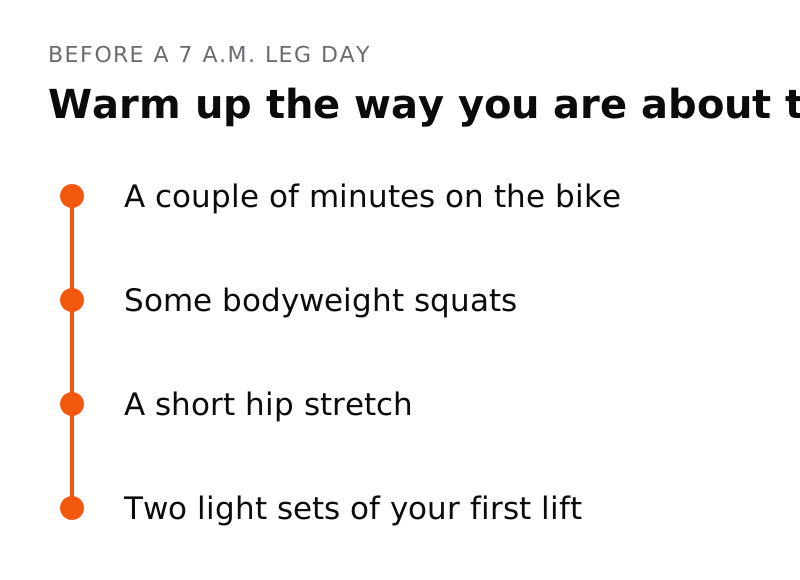
Warm up the way you are about to lift. Take each joint through the range you will train, using light sets or dynamic moves, and add short static holds where a muscle feels tight. Short holds do not hurt your performance, so there is no need to avoid them before a heavy session.
Before a 7 a.m. leg day, that might mean a couple of minutes on the bike, some bodyweight squats, a short hip stretch and two light sets of your first lift.
Where does stretching fit with strength training and recovery?
Alongside them. Stretching on its own is not a complete injury-prevention plan, while strength programs cut injury risk in athletes by about 30%. Together, the two cover both range and resilience.
That holds even on a busy day. "If I have a client who only has 15 minutes or so during the course of a day for some sort of fitness activity, I would recommend squats, push-ups, crunches and either jumping jacks or burpees. (assuming no equipment is available). Over a 4 week span, the client would see cardiovascular improvement along with improved muscular endurance."
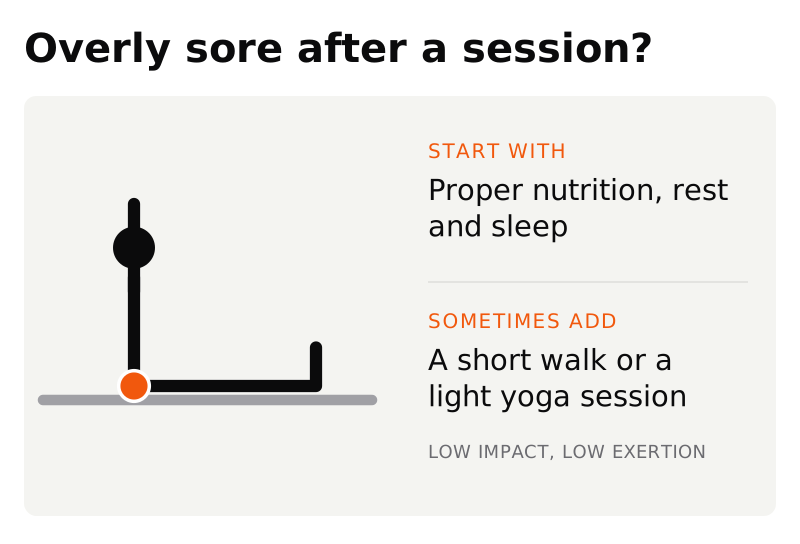
Recovery starts with the basics, and gentle movement helps. "From a recovery standpoint. Nothing beats proper nutrition and rest/sleep. This is when our body's go into repair mode. If I have a client that is overly sore following a session, aside from rest and nutrition, sometimes an active rest day is beneficial. Maybe going for a short walk or light yoga session,(low impact & low exertion). Helps reduce muscle soreness and stiffness."
A stretch with a job is worth ten done out of habit.

Michael Hawkins is an ISSA-certified strength coach with 25 years of strength training and a member of the Shifu Health coaching team.
This article was written by the Shifu Health team and reviewed for accuracy by Michael Hawkins, ISSA-certified strength coach.
Sources
- Warneke K, et al. Practical recommendations on stretching exercise: a Delphi consensus statement of international research experts. Journal of Sport and Health Science, 2025.
- Chen Z, et al. Adherence to strength training and lower rates of sports injury in contact sports: a systematic review and meta-analysis. Orthopaedic Journal of Sports Medicine, 2025.
- Warneke K, Lohmann LH. Revisiting the stretch-induced force deficit: a systematic review with multilevel meta-analysis of acute effects. Journal of Sport and Health Science, 2024.
- Konrad A, et al. Detraining effects following chronic stretching training on range of motion: a systematic review and meta-analysis. Sports Medicine – Open, 2025.
General wellness guidance only. Not medical advice, diagnosis, or treatment.